Army Directive 2026-13 Explained: New Army Body Composition Rules
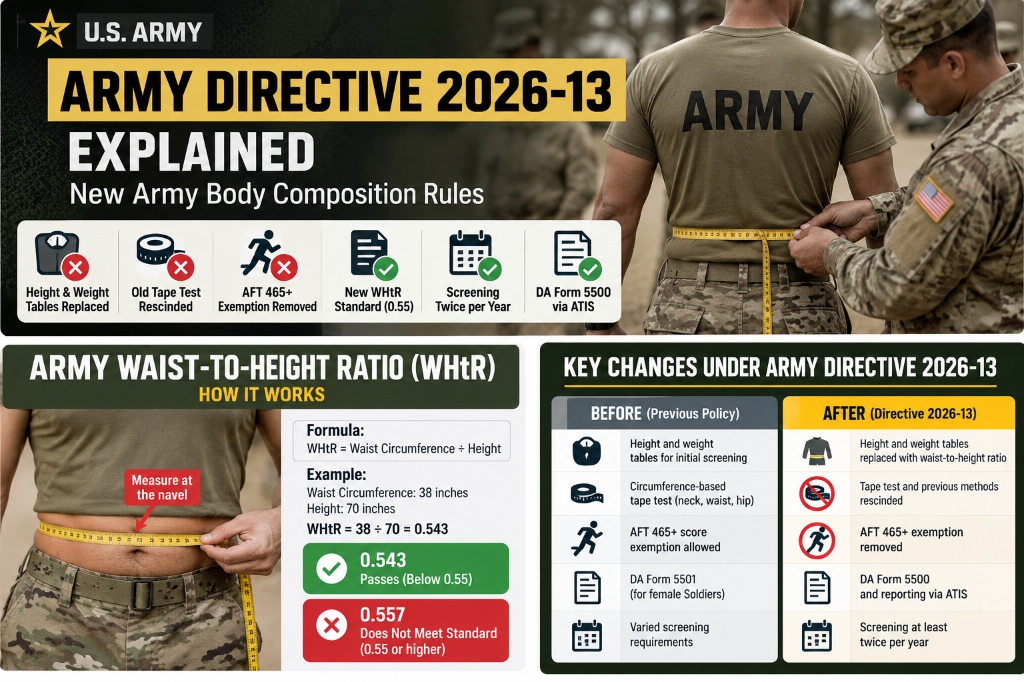
Army Directive 2026-13, titled Army Body Composition Program and Standards, introduces a major change to how the U.S. Army evaluates Soldiers' body composition. Published on July 7, 2026, the directive replaces the traditional height and weight screening tables and previous tape-based body fat assessment methods with the Waist-to-Height Ratio (WHtR).
The purpose of this update is to simplify body composition screening, improve consistency, and support Soldier health and military readiness. Under the new policy, a Soldier's waist circumference is compared with their height to determine whether they meet the required standard.
In this guide, you will learn what Army Directive 2026-13 changes, how the new standard works, which forms are required, and what Soldiers should understand about the updated Army Body Composition Program (ABCP).
What Is Army Directive 2026-13?
Army Directive 2026-13 establishes updated requirements for the Army Body Composition Program. It introduces the waist-to-height ratio as the authorized body composition screening method for Soldiers covered by the directive.
Previously, the Army used height and weight tables, followed by additional circumference-based measurements when necessary. The new policy replaces these assessment methods with a single ratio based on waist circumference and height.
The directive applies to the Regular Army, Army National Guard, and U.S. Army Reserve, subject to applicable policy provisions and exemptions.
The main changes include:
- Replacing traditional height and weight screening tables: The legacy Table B-1 screening weights have been completely retired. You can examine these former standards in our Old Screening Table Archive.
- Discontinuing previous tape-test and supplemental body fat assessment methods: Former neck, abdomen, and hip taping calculations have been rescinded. Review how those were assessed with our Army Body Fat Calculator.
- Establishing a waist-to-height ratio below 0.55 as the passing standard: Test your own measurements using our interactive Army Height and Weight Calculator.
- Requiring body composition screening at least twice per calendar year: Institutionalizing regular assessments across all active and reserve components.
- Updating documentation and reporting procedures through DA Form 5500 and ATIS: Screenings are now recorded directly in the Army Training Information System (ATIS) Leader Tool.
- Removing the previous performance-based exemption for high Army Fitness Test scores: A high physical fitness score no longer exempts Soldiers from the screening. Calculate your event scores on our AFT Score Calculator.
These changes are intended to make Army body composition assessments more consistent and easier to administer.
What Is the New Army Waist-to-Height Ratio Standard?
The Waist-to-Height Ratio, commonly abbreviated as WHtR, compares a person's waist circumference with their height. The Army uses this measurement to screen body composition under the updated policy.
The standard is straightforward: a WHtR below 0.55 meets the screening threshold, while a result of 0.55 or higher does not meet the standard.
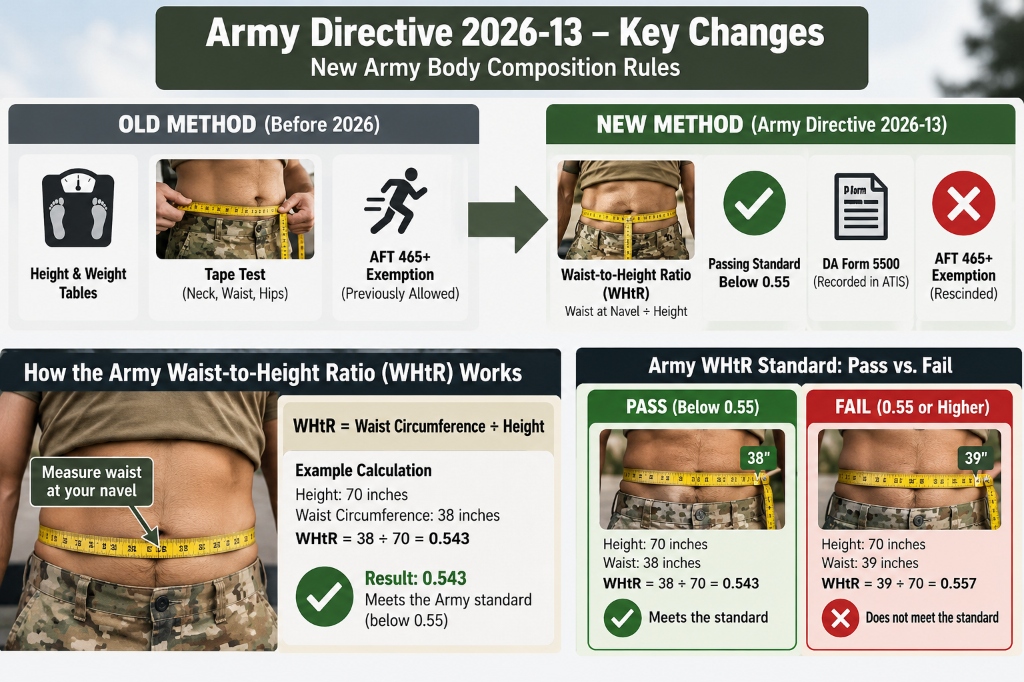
For example, consider a Soldier who is 70 inches tall and has a waist circumference of 38 inches.
Passing Calculation Example:
WHtR = Waist Circumference ÷ Height
WHtR = 38 ÷ 70 = 0.543
Result: Because 0.543 is below 0.55, it meets the numerical screening threshold and passes.
Now consider a Soldier who is 70 inches tall with a 39-inch waist:
Non-Passing Calculation Example:
WHtR = 39 ÷ 70 = 0.557
Result: This result exceeds the 0.55 threshold and does not meet the standard, requiring the confirmation procedure established by Army policy.
For a convenient calculation, use our Army Height and Weight Calculator to explore the relevant measurements and understand how waist-to-height ratio is calculated, or follow our complete tutorial on How to Calculate WHtR for Army (Formula & Examples).
Why Did the Army Replace Height and Weight Tables?
Traditional height and weight tables do not always reflect differences in body composition. Two Soldiers with the same height and weight may have different proportions of muscle and body fat.
The Army's transition to WHtR is intended to provide a more consistent, health-focused screening approach. Waist circumference relative to height can help identify abdominal fat-related health risks without relying on multiple height and weight tables.
According to the Army's official guidance, the change is designed to improve consistency, reduce subjectivity, simplify administrative procedures, and support force readiness.
However, WHtR is a screening measure rather than a complete medical assessment. It does not independently diagnose a medical condition or measure every aspect of physical fitness. Soldiers interested in how their body composition compares against historical standards can explore our Old Height and Weight Calculator.
What Happened to the Army Tape Test and Body Fat Exemptions?
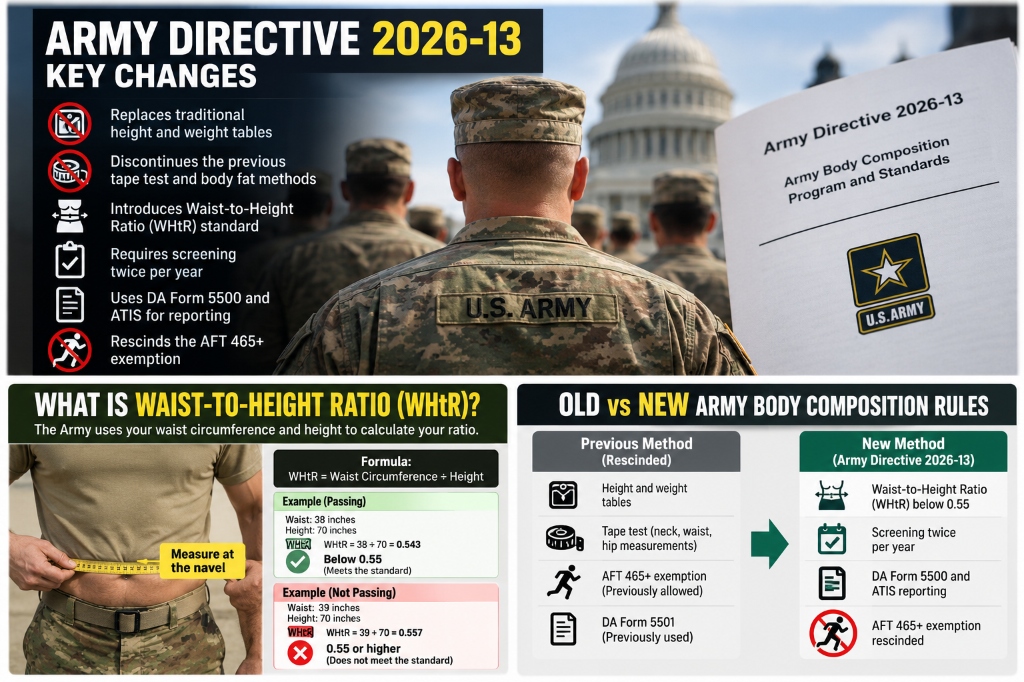
Under Army Directive 2026-13, previous body composition assessment methods, including the circumference-based tape test, have been rescinded as authorized assessment methods for the program. Soldiers are no longer measured across multiple circumference sites (such as neck and hips) under the standard screening workflow. If you want to understand how the multi-site calculation functioned historically, visit our Army Body Fat Tape Test Calculator.
The previous performance-based exemption for Soldiers scoring 465 or higher on the Army Fitness Test (AFT) has also been rescinded. Soldiers must meet the WHtR standard regardless of their AFT score. To track your current 5-event readiness events, utilize our AFT Score Calculator.
Existing medical exemptions for pregnant and postpartum Soldiers remain in effect.
These updates are important because older Army body composition articles may still describe tape-test calculations, neck measurements, or fitness-score exemptions that no longer reflect the current policy.
Soldiers should consult the latest official Army guidance rather than relying solely on older charts or unofficial calculators.
What Happens If a Soldier Fails the WHtR Screening?
A result of 0.55 or higher does not immediately complete the process. The directive requires a confirmation measurement on the same duty day, conducted by a different certified team.
If the Soldier still does not meet the standard after the confirmation measurement, the Soldier will be enrolled in the Army Body Composition Program (ABCP) and flagged according to applicable procedures under AR 600-8-2.
Soldiers enrolled in the program may receive appropriate counseling, nutritional education, and support to help them meet the standard. To monitor mandatory monthly targets (such as 3 to 8 pounds per month or waist reductions), Soldiers can use our ABCP Progress Tracker Calculator.
The Army has also established an initial 180-day assessment period for the new policy. Under the published guidance, separation actions for WHtR failure will not occur until the Army completes its assessment and issues further guidance.
Because administrative requirements can change, Soldiers should confirm their individual circumstances with their chain of command and consult the current Army policy.
Which Forms Are Required Under Army Directive 2026-13?
The updated policy changes how waist-to-height ratio results are documented.
DA Form 5500 is used to record the WHtR assessment, and the Army Training Information System (ATIS) provides the associated digital reporting process through the Leader Tool.
DA Form 5501, previously associated with the former assessment process for female Soldiers, is no longer used under the new policy because the waist-to-height screening method applies equally across all Soldiers.
The directive also establishes an implementation timeline for recording Soldiers' WHtR screenings in ATIS. Soldiers and unit leaders should refer to current official instructions for the applicable deadlines and reporting procedures.
Frequently Asked Questions
Does Army Directive 2026-13 apply to Army Reserve and National Guard Soldiers?
Yes. The directive covers the Regular Army, Army National Guard, and U.S. Army Reserve, subject to its applicable provisions.
What is the passing WHtR for the U.S. Army?
The published standard is a waist-to-height ratio below 0.55. A result of exactly 0.55 does not meet the standard.
Can a high AFT score exempt a Soldier from WHtR requirements?
No. The previous exemption for an AFT score of 465 or higher has been rescinded.
Is the old Army tape test still authorized?
No. The previous circumference-based tape test and other former body composition assessment methods have been rescinded under the new policy.
Will a Soldier be separated immediately for failing WHtR?
No immediate separation occurs solely because of an initial failed screening. The policy requires a confirmation measurement, and the Army's published guidance establishes an initial 180-day assessment period before separation actions for WHtR failure can proceed under further guidance.
Final Thoughts
Army Directive 2026-13 represents a significant update to the U.S. Army Body Composition Program. By replacing traditional height and weight screening tables and previous tape-based assessment methods with waist-to-height ratio, the Army aims to improve consistency, simplify screening, and support Soldier health and readiness.
Understanding the WHtR formula, the 0.55 threshold, confirmation procedures, and updated reporting requirements can help Soldiers prepare for the new screening process.
For the most accurate information, consult the official Army resources and use a calculator as an educational aid rather than a substitute for an official assessment.